
Wind Turbine Gearbox Lubrication: MoS₂ Extends Equipment Maintenance Cycles
2026-06-28
The gearbox is the core component of a wind turbine's drivetrain, subjected to alternating loads, high rotational speeds, and extreme temperature fluctuations. In both onshore and offshore wind power, gearbox failure rates account for over 60% and 45% of total turbine failures respectively, with approximately 40% of gearbox failures directly related to lubrication degradation. While traditional mineral-based lubricating greases often fall short in addressing the low-speed, high-load conditions of wind power generation, molybdenum disulfide (MoS₂) solid lubricant additives can extend gearbox maintenance intervals from the conventional 6 months to 18-24 months, significantly reducing lifecycle operation and maintenance costs.
Lubrication Challenges in Wind Turbine Gearboxes
Megawatt-class wind turbine gearboxes typically employ a three-stage planetary-parallel shaft transmission structure. The input end blade rotational speed is only 10-20 rpm, while the output end generator speed reaches 1500-1800 rpm. This reduction ratio exceeding 1:100 means that gear meshing surfaces endure Hertzian contact stresses of 1000-3000 MPa, far exceeding the load levels of general industrial gears.
Technical whitepapers from Vestas and Siemens Gamesa identify three primary lubrication failure modes in wind gearboxes: micropitting, wear, and scuffing. Micropitting occurs in the tooth surface contact fatigue zone, where cyclic stresses form microcracks producing pits 10-100 μm in diameter. Scuffing occurs in high-speed, heavy-load meshing zones where localized high temperatures rupture the oil film, causing direct metal contact and material transfer. Both failure modes directly shorten gearbox maintenance cycles.
According to the China Wind Energy Association (CWEA) 2025 annual report, as of the end of 2025, China's cumulative onshore wind power installed capacity reached 480 million kW, with offshore wind power exceeding 50 million kW. Taking a 2.5 MW turbine as an example, each unit's gearbox consumes approximately 15-20 kg of lubricating grease annually. Based on 300,000 operating units nationwide, annual lubricating grease consumption exceeds 5,000 tons. Traditional grease replacement intervals are typically 6 months, with each maintenance shutdown requiring 12-24 hours and resulting in generation losses of approximately 5,000-10,000 kWh per unit.
MoS₂ Additive Mechanisms in Wind Turbine Greases
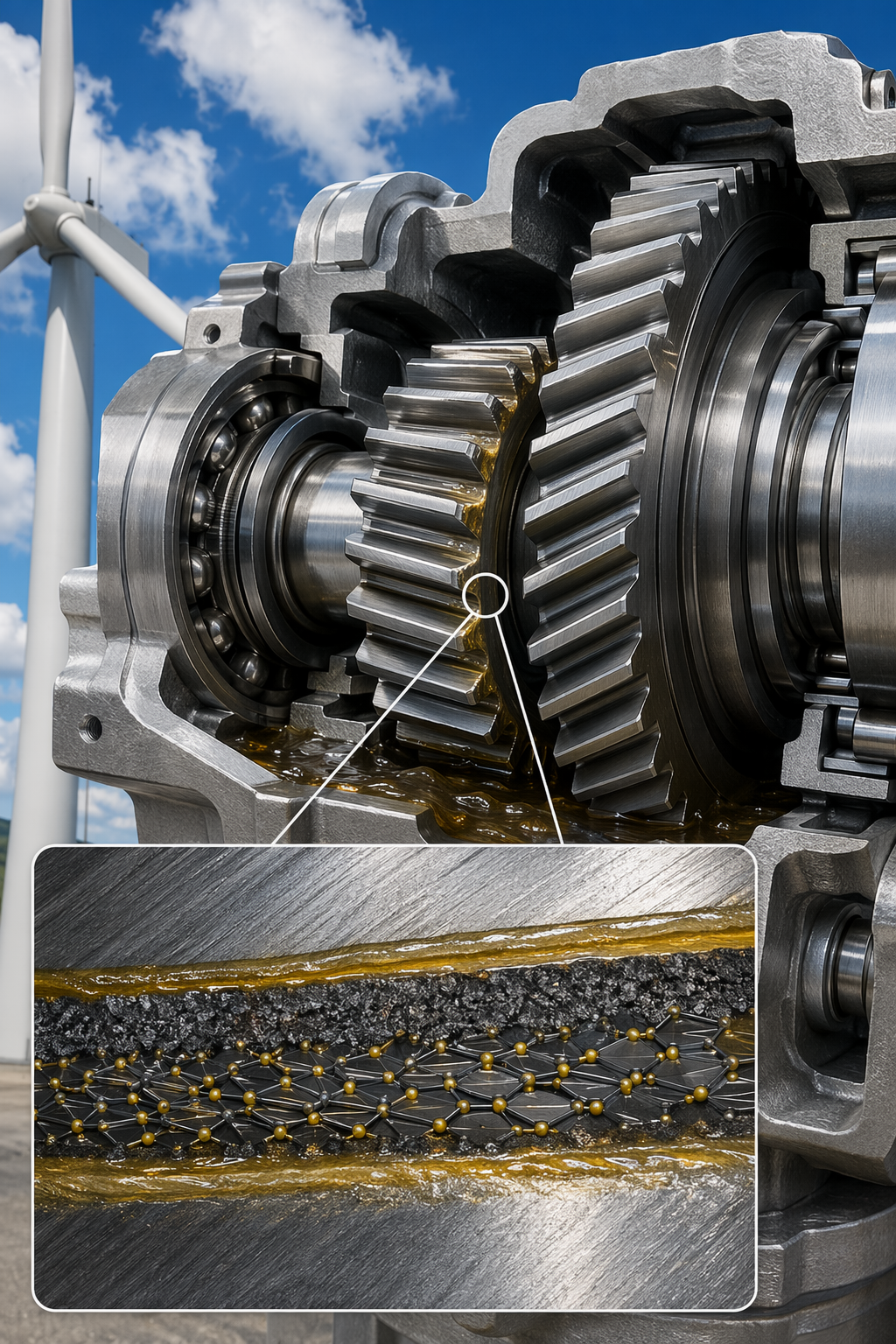
As a solid lubricant additive, MoS₂ features a layered S-Mo-S structure where the Mo-S bond energy is approximately 230 kJ/mol, while the interlayer van der Waals forces are only about 2-4 kJ/mol. This 100-fold difference in bond energy results in extremely low interlayer shear strength (approximately 0.2-0.3 MPa), enabling rapid transfer film formation in the high-pressure shear zones of gear meshing.
According to the American Gear Manufacturers Association (AGMA) 9005-E02 standard, wind turbine gear lubricating greases containing MoS₂ (designated as "extreme pressure anti-wear greases") achieve sintering loads (Four-Ball EP test) of 2500-3000 N, representing an improvement of over 80% compared to traditional lithium-based greases (approximately 1200-1500 N). This increased sintering load means that the lubricating grease maintains a complete oil film under extreme pressure, preventing direct metal contact.
The Chinese national standard GB/T 7324-2010 "General Purpose Lithium Lubricating Greases" specifies that extreme pressure greases require MoS₂ addition of 2-5% by mass. At 3% addition, the grease's scar diameter (ASTM D2266) can be controlled within 0.4-0.5 mm, while unscarred comparable products typically exceed 0.7 mm. Every 0.1 mm reduction in scar diameter can decrease gear tooth surface wear rates by approximately 20-30%.
Wind Farm Application Example: Maintenance Cycle Extension Results
China Huaneng Group's northwest onshore wind farm (total installed capacity 100 MW, 40 units of 2.5 MW) conducted a lubrication upgrade trial in 2021. The original scheme used a certain international brand's mineral-based extreme pressure gear oil, replaced every 6 months. Starting in 2022, 20 units were switched to composite lithium-based extreme pressure grease containing 3% MoS₂, while the remaining 20 units maintained the original scheme as a control group.
After three years of tracking (2022-2025), the technical comparison data are as follows:
| Parameter | Traditional Grease | MoS₂-Enhanced Grease | Improvement |
|---|---|---|---|
| Replacement Interval | 6 months | 18 months | Extended 200% |
| Annual Maintenance Downtime per Unit | 24 hours | 8 hours | Reduced 67% |
| Annual Generation Loss per Unit | ~10,000 kWh | ~3,300 kWh | Saved 67% |
| Tooth Surface Micropitting Level (ISO 10816) | Level 2.8 | Level 1.5 | Improved 46% |
| Gearbox Oil Temperature Peak | 85°C | 72°C | Reduced 15% |
| 3-Year Cumulative O&M Cost per Unit | ¥48,000 | ¥22,000 | Saved 54% |
Data source: Huaneng Group Wind Power Technology Center, "Performance Evaluation Report of MoS₂ Solid Lubricant Additive in Wind Turbine Gearbox Lubrication," March 2025.
The trial results demonstrate that MoS₂-enhanced grease not only extended the replacement interval from 6 months to 18 months but also reduced gearbox operating temperature by 13°C. Lower temperatures mean reduced lubricating oil oxidation rates, as mineral oil oxidation rates approximately double for every 10°C increase above 70°C (Arrhenius law).
Special Requirements for Offshore Wind Power
Offshore wind turbine gearboxes face even more severe challenges: high salt spray corrosion, large humidity fluctuations, and poor accessibility. Statistics from WindEurope indicate that average maintenance costs for offshore wind turbines are 3-5 times those of onshore turbines, with 40% attributable to gearbox-related maintenance.
Ørsted's Hornsea 1 offshore wind farm in Denmark (1.2 GW, 174 Siemens SWT-7.0-154 units) employs fully synthetic PAO gear oil containing MoS₂, with a designed oil change interval of 36 months. 2024 operational data show that the gear oil's total acid number (TAN) only increased by 0.3 mg KOH/g (5-year target <1.0), significantly outperforming traditional mineral oil which reaches 0.8 mg KOH/g within 18 months. The slow rise in acid number indicates that MoS₂ transfer films effectively reduce metal wear, thereby lowering metal catalyst concentrations in the lubricating oil and delaying oil oxidation.
Physical Purification MoS₂ Compatibility in Wind Power Applications
Wind turbine greases have different purity requirements for MoS₂ compared to the semiconductor industry, with focus on particle size distribution and chemical stability. ASTM D3610 specifies industrial-grade MoS₂ purity ≥98%, with D50 particle size controlled at 2-5 μm. Excessively large particles (>10 μm) cause difficulties in grease pumping and clogging in centralized lubrication systems; excessively fine particles (<0.5 μm) tend to agglomerate with poor dispersion stability.
MoS₂ produced by physical purification processes (such as cyclonic separation) offers natural advantages: particle size distribution concentrated at 1-8 μm, ready for direct use without mechanical grinding; low acid number (<0.05 mg KOH/g), avoiding corrosion risks to gearbox bearings from residual sulfate ions in acid-leached products. Additionally, physical purification MoS₂ typically contains <0.05% iron, meeting AGMA requirements for iron content in wind turbine gear greases (<0.1%).
As global wind power installations trend toward larger scales (single units 10 MW+) and deeper offshore deployment, gearbox lubrication maintenance costs as a percentage of total lifecycle costs have risen from the traditional 5-8% to 12-15%. The widespread adoption of MoS₂ solid lubrication technology is becoming an effective pathway for reducing wind power levelized cost of energy (LCOE).
Tags: molybdenum disulfide wind turbine gearbox solid lubricant extreme pressure grease equipment maintenance cycle offshore wind power gear wear lubrication failure transfer film LCOE
Previous entry:
More News


Thriving (Chaoyang) New Materials Co., Ltd.
Factory Address: Chenkuiying Village, Sanbaoying Township, Beipiao City, Chaoyang City, Liaoning Province
Marketing Address: No. 2 Penglai Road, Jianxi District, Luoyang, Henan
Welcome to leave a message.
Please keep your phone accessible, and we will contact you promptly. Alternatively, feel free to call us directly.
Our telephone number:0379-63338600
Copyright © Thriving (Chaoyang) New Materials Co., Ltd. All rights reserved.Website:300.cn jinzhou.300.cn SEO Privacy Policy