
MoS₂ Batch Quality Control: How ISO 9001 Ensures Product Consistency
2026-08-18
Molybdenum disulfide (MoS₂), as a core solid lubricant in industrial lubrication and material modification, requires strict batch-to-batch consistency to ensure stable performance in downstream products. In powder metallurgy, lubricant formulation, and plastic modification applications, variations in purity, particle size, and impurity levels across different batches of MoS₂ can cause finished product performance deviations, leading to customer complaints or even production line shutdowns. The ISO 9001 quality management system provides a systematic framework to address this industry challenge.
Root Causes of Batch Quality Variation
In MoS₂ production, batch variations primarily originate from three dimensions: fluctuations in molybdenite concentrate grade (Mo content typically ranging 45%-55%), process parameter drift during purification (temperature, pressure, reaction time), and classification precision during post-processing. The traditional acid-leaching method, due to difficulty in precisely controlling reaction conditions, can produce MoS₂ batches with purity fluctuations of 2%-3%, with copper corrosion ratings shifting from 1a to 2a, directly affecting the anti-corrosion performance of lubricating greases.
Physical separation via hydrocyclone classification avoids the uncertainty of strong acid reactions through a non-acid route, but still requires ISO 9001 process controls to lock in parameters. Key control points include maintaining cyclone feed pressure at 0.4-0.6 MPa, achieving classification precision of D50=1.5μm±0.3μm, and controlling moisture content to ≤0.5%.
Key Control Points in the ISO 9001 System
The ISO 9001:2015 standard requires a documented quality management system covering the entire process from raw material receipt to finished product dispatch. In MoS₂ production, the practical implementation includes the following core elements:
**Raw Material Control**: Each batch of molybdenite concentrate must arrive with a third-party test report. Internal verification covers Mo content and heavy metal impurities (Pb≤0.05%, Cu≤0.30%); non-compliant batches are rejected outright. Raw materials are stored with batch isolation to ensure traceability.
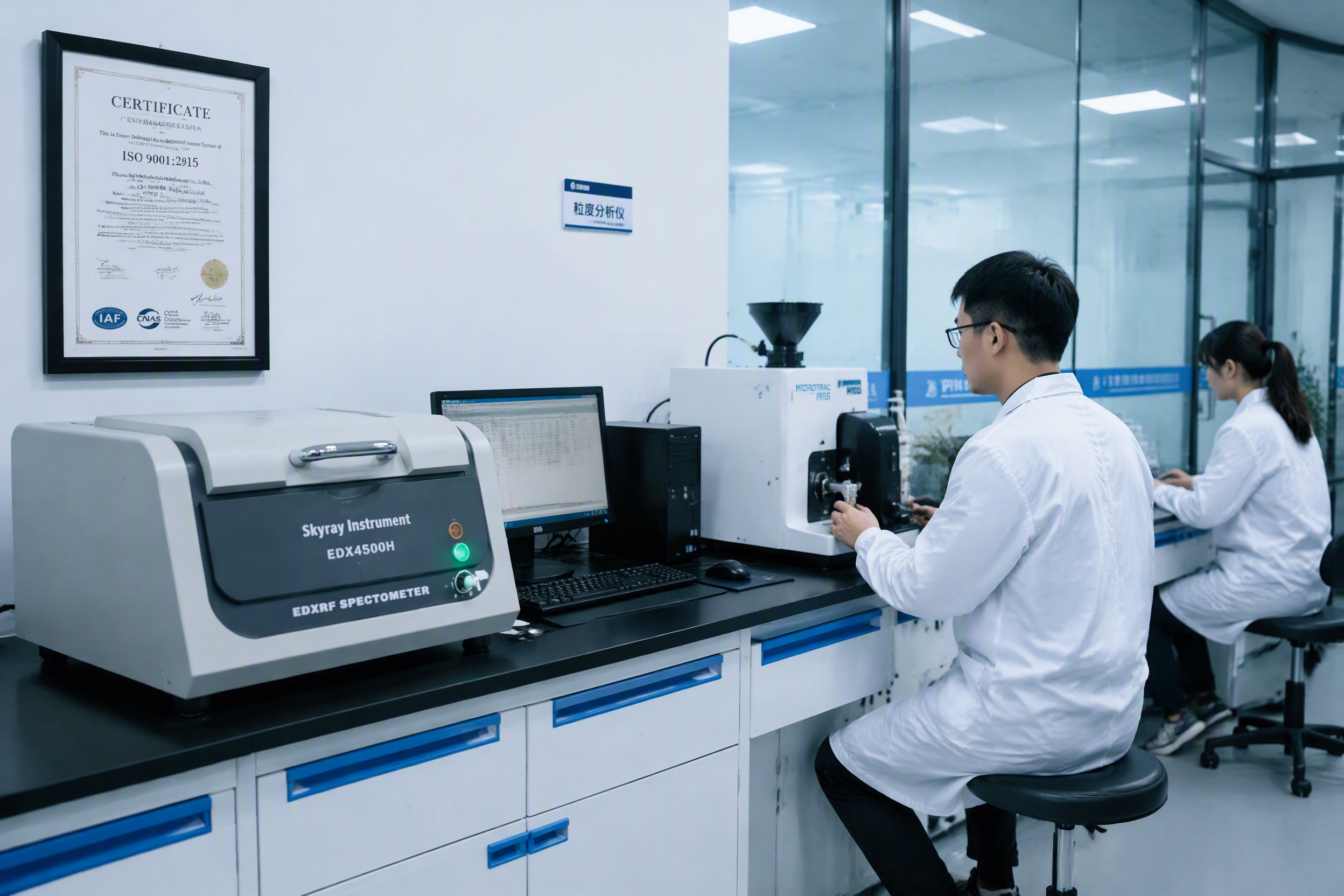
**Process Monitoring**: Six critical quality control checkpoints are established along the production line—raw material inspection, purification, particle classification, purity testing, packaging verification, and shipment audit. Each checkpoint records measured data and uploads it to the quality database; any indicator exceeding control limits immediately triggers corrective action. For purity testing, dual verification using X-ray fluorescence (XRF) and chemical analysis ensures MoS₂ content ≥99%.
**Finished Product Testing**: Each batch comes with a test report covering five core indicators: MoS₂ purity (≥99%), iron content (≤0.02%), moisture (≤0.5%), particle size distribution (D50 value), and copper corrosion rating (1a). Reports are sent with the shipment and retained for at least 3 years.
Traceability and Continuous Improvement
The ISO 9001 traceability requirement in the MoS₂ industry manifests as a "one code to end" mechanism: each finished batch is labeled with a unique batch number, enabling reverse traceability to raw material batch, production date, process parameters, and test data. Industry-leading companies have reduced full-chain traceability response time to within 48 hours.
For continuous improvement, ISO 9001 requires regular internal audits and management reviews. Manufacturers typically track batch pass rates, customer complaint rates, and return rates quarterly, using Pareto charts to analyze major nonconformities and implement corrective actions with verification. Data shows that MoS₂ producers strictly adhering to ISO 9001 achieve batch pass rates consistently above 99.5%, with customer complaint rates reduced by over 60%.
Certification Value and Industry Selection
ISO 9001 certification is not merely proof of quality management capability—it is a prerequisite for entering high-end supply chains. Automotive, aerospace, and electronics industry procurement of MoS₂ typically lists ISO 9001 certification as a mandatory supplier qualification. Products exported to the EU market must also comply with RoHS testing to ensure heavy metal content meets limit requirements.
When selecting a MoS₂ supplier, buyers should verify the validity of the ISO 9001 certificate and request batch test reports from the past 3 months, focusing on the variation ranges of three key indicators: purity, particle size distribution, and copper corrosion rating. Narrower variation ranges indicate stronger process control capability.
---
**SEO Tags:** MoS₂ batch quality | 二硫化钼批次质量 | ISO 9001 quality management | particle size D50 control | copper corrosion rating 1a | solid lubricant quality control | quality traceability system | MoS₂ purity 99% | batch consistency | molybdenite raw material control
Previous entry:
More News


Thriving (Chaoyang) New Materials Co., Ltd.
Factory Address: Chenkuiying Village, Sanbaoying Township, Beipiao City, Chaoyang City, Liaoning Province
Marketing Address: No. 2 Penglai Road, Jianxi District, Luoyang, Henan
Welcome to leave a message.
Please keep your phone accessible, and we will contact you promptly. Alternatively, feel free to call us directly.
Our telephone number:0379-63338600
Copyright © Thriving (Chaoyang) New Materials Co., Ltd. All rights reserved.Website:300.cn jinzhou.300.cn SEO Privacy Policy