
MoS2 Chemical Stability: Analysis of Acid-Alkali Resistance and Antioxidant Properties
2026-08-17
The chemical stability of molybdenum disulfide (MoS₂) is the foundation for its long-term reliable operation in harsh industrial environments. As a layered transition metal sulfide, MoS₂ is nearly completely inert to water, dilute acids, and dilute alkalis at room temperature, and does not begin to oxidize noticeably in air until 350°C. This combination of acid-alkali resistance and oxidation resistance makes it irreplaceable in chemical processing equipment, marine engineering, and lubrication under corrosive media. This article analyzes the origin of MoS₂ chemical inertness from a crystal chemistry perspective and quantifies its stability boundaries in various media.
Contribution of Crystal Structure to Chemical Stability
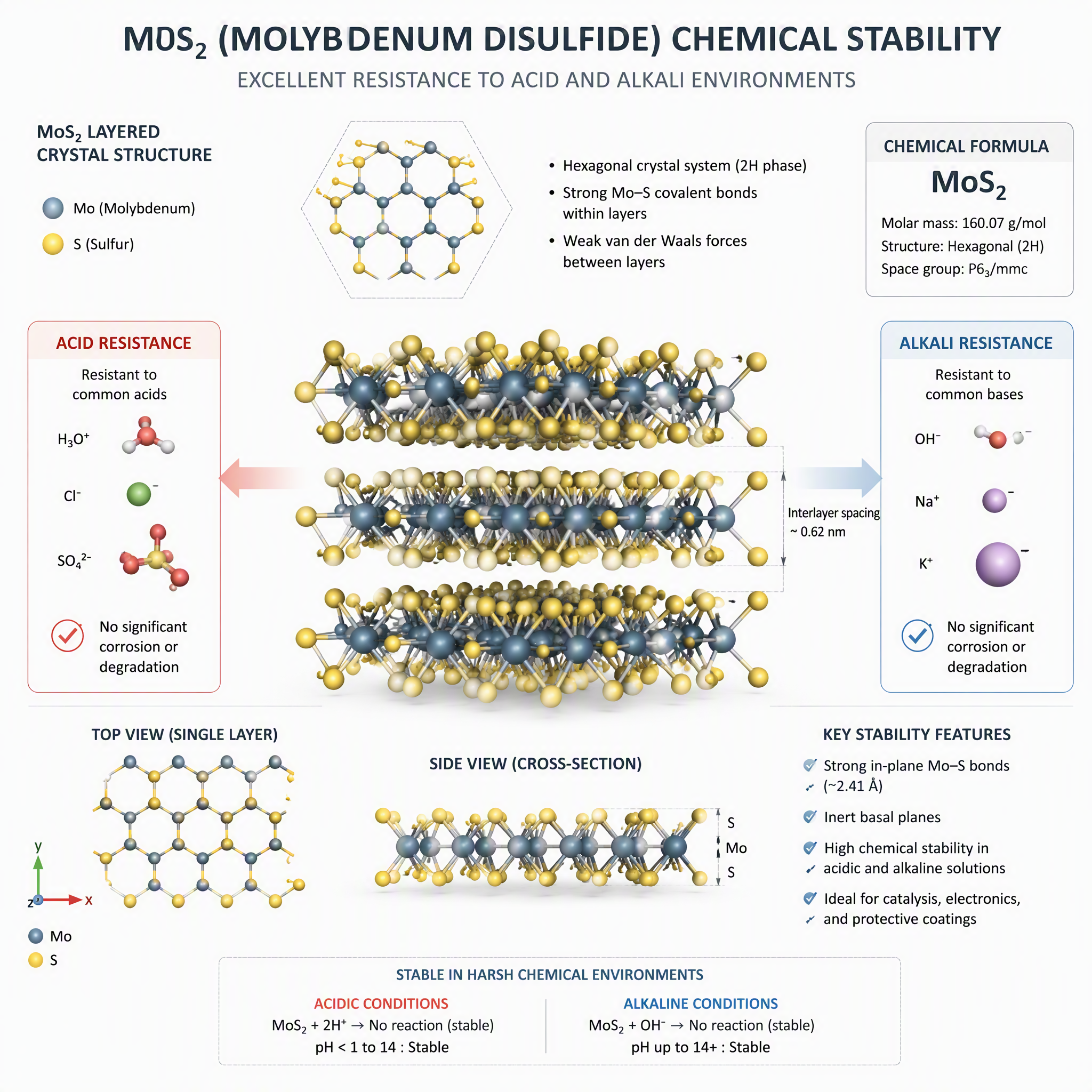
The chemical inertness of MoS₂ originates from the electron configuration of the S-Mo-S trilayer units in its crystal structure. Each molybdenum atom is coordinated by six sulfur atoms in a trigonal prismatic arrangement, with a Mo-S bond length of 0.241 nm and bond energy of approximately 274 kJ/mol. The outer electron pairs of sulfur atoms form strong covalent bonds with the d-orbitals of molybdenum, leaving the molybdenum in a low-valence state (Mo⁴⁺) fully encapsulated by sulfur layers. This "sandwich" structure means that reactive molybdenum atoms are shielded by inert sulfur layers, making it difficult for corrosive media to directly access the metal atoms.
In the hexagonal 2H-MoS₂ crystal system, the interlayer spacing is 0.349 nm, with layers held together only by van der Waals forces. This structure means that chemical attack occurs primarily at layer edges where unsaturated dangling bonds are present, while the basal plane exhibits extremely low chemical reactivity due to the full-shell electron configuration of sulfur atoms. Atomic force microscopy (AFM) studies show that after immersion in aqueous solutions ranging from pH 1 to pH 14 for 72 hours, the surface roughness change of the MoS₂ basal plane is less than 0.1 nm, confirming the chemical inertness of the basal plane.
Quantitative Analysis of Acid and Alkali Resistance
In acid media, MoS₂ exhibits significant corrosion resistance. After 24 hours of immersion at room temperature in hydrochloric acid (HCl, 37% concentration), nitric acid (HNO₃, 10% concentration), and sulfuric acid (H₂SO₄, 50% concentration), the weight loss rates of MoS₂ powder are below 0.1%, 0.3%, and 0.2% respectively (ASTM G31 immersion corrosion standard method). Only aqua regia (a mixture of concentrated HNO₃ and concentrated HCl at a 1:3 volume ratio) and hot concentrated sulfuric acid (concentration >90%, temperature >150°C) can significantly dissolve MoS₂, producing molybdic acid (H₂MoO₄) and sulfur dioxide (SO₂).
In alkaline media, MoS₂ maintains good stability. In sodium hydroxide (NaOH) solutions at concentrations of 5%-30% and temperatures of 25-80°C, the dissolution rate of MoS₂ after 48 hours of immersion is below 0.05 mg/(cm²·h). By comparison, metallic molybdenum powder dissolves at 0.5-1.2 mg/(cm²·h) in the same NaOH solutions, indicating that sulfide-state molybdenum is significantly more chemically stable than the metallic state. In ammonia water (NH₃·H₂O, 25% concentration), MoS₂ is stable at room temperature but slowly forms ammonium molybdate complexes when heated above 80°C.
Oxidation Resistance and Temperature Boundaries
MoS₂ has a well-defined temperature boundary for oxidation resistance in air. Thermogravimetric analysis (TGA) data shows that MoS₂ begins to show detectable mass increase from approximately 350°C in air, corresponding to the oxidation reaction: 2MoS₂ + 7O₂ → 2MoO₃ + 4SO₂. The oxidation rate is approximately 0.1%/min (mass increase rate) at 400°C and accelerates to approximately 1%/min at 500°C. The oxidation product, molybdenum trioxide (MoO₃), is a pale yellow solid with a melting point of 795°C that begins to sublime above 700°C.
In inert atmospheres (nitrogen or argon) and vacuum, the thermal stability of MoS₂ improves substantially. In argon atmosphere, MoS₂ shows no significant decomposition below 1000°C; under vacuum conditions (10⁻³ Pa), MoS₂ maintains structural stability below 1100°C and begins to decompose into metallic molybdenum and sulfur vapor above 1185°C. This temperature range data comes from differential scanning calorimetry (DSC) measurements, with decomposition peak temperatures in the range of 1185-1205°C, consistent with the nominal melting point of MoS₂.
Industrial Applications Driven by Chemical Stability
The acid-alkali resistance and oxidation resistance of MoS₂ enable its critical role in multiple industrial sectors. In chemical pump and valve seal surface lubrication, MoS₂ coatings can operate long-term in media with pH 2-12 without degradation, achieving service life of 2000-5000 hours. In marine environments, MoS₂-based lubricating grease tolerates salt spray (5% NaCl solution spray, GB/T 10125 standard) for over 1000 hours, far superior to petroleum-based grease at 200-400 hours. In electrochemical corrosion protection, MoS₂ added as a corrosion inhibitor in anti-corrosion coatings can reduce the corrosion current density of carbon steel in 3.5% NaCl solution from 10⁻⁵ A/cm² to the 10⁻⁶ A/cm² level (ASTM G5 polarization curve testing).
---
**Tags**: 二硫化钼, MoS2, 化学稳定性, chemical stability, 耐酸碱, acid alkali resistance, 抗氧化, oxidation resistance, 腐蚀防护, corrosion protection
Previous entry:
More News


Thriving (Chaoyang) New Materials Co., Ltd.
Factory Address: Chenkuiying Village, Sanbaoying Township, Beipiao City, Chaoyang City, Liaoning Province
Marketing Address: No. 2 Penglai Road, Jianxi District, Luoyang, Henan
Welcome to leave a message.
Please keep your phone accessible, and we will contact you promptly. Alternatively, feel free to call us directly.
Our telephone number:0379-63338600
Copyright © Thriving (Chaoyang) New Materials Co., Ltd. All rights reserved.Website:300.cn jinzhou.300.cn SEO Privacy Policy