
Conductive Lubricating Materials: Special Applications and Conduction Mechanisms of MoS2 in the Electronics Industry
2026-08-14
The application of molybdenum disulfide in the electronics industry originates from its unique semiconductor characteristics—bandgap of 1.2-1.8 eV (thickness-dependent), with conductivity type controllable through doping to n-type or p-type. Unlike traditional conductive lubricants such as graphite, MoS₂ achieves conductivity of 10²-10³ S/cm in nanoscale thin layers, while its interlayer shear strength is only 2.5 MPa, providing irreplaceable advantages in scenarios requiring both electrical contact and friction-wear control. According to published literature, adding 3-8 wt% MoS₂ to electrical contact materials stabilizes contact resistance within 5-15 mΩ (ASTM B667 test conditions, 1N contact pressure), while reducing arc erosion by 30%-50%.
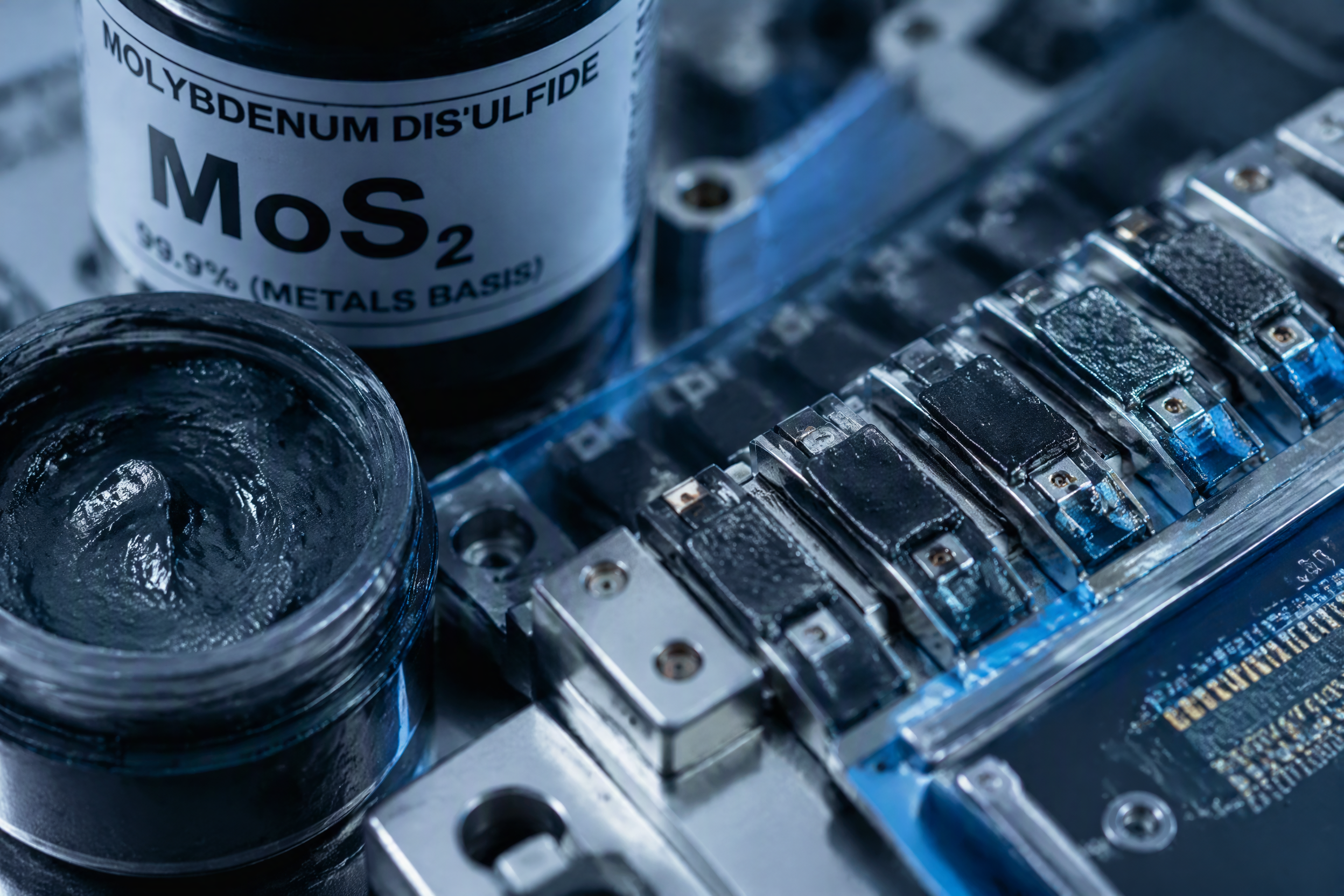
Balance Between MoS₂ Conductivity and Lubrication Performance
The conduction mechanism of molybdenum disulfide is closely related to its crystal structure. Bulk MoS₂ is an indirect bandgap semiconductor (bandgap ~1.2 eV), transitioning to a direct bandgap semiconductor (bandgap ~1.8 eV) when exfoliated to a monolayer, with carrier mobility reaching 200-500 cm²/V·s. In electrical contact applications, MoS₂ conductivity is characterized through Hall effect measurements—n-type MoS₂ has carrier concentrations of 10¹⁶-10¹⁸ cm⁻³ and resistivity in the range of 10⁻²-10 Ω·cm. Although this resistivity is higher than metals (copper at 1.68×10⁻⁶ Ω·cm), controlling MoS₂ orientation and distribution in composites enables conductive pathways meeting engineering requirements.
In silver-based electrical contact materials (Ag-MoS₂), MoS₂ addition achieves the dual goals of conductivity and lubrication. Silver's conductivity is 6.3×10⁷ S/m; when 5 wt% MoS₂ is added, the composite volume resistivity increases from 1.6×10⁻⁸ Ω·m to 3.2×10⁻⁸ Ω·m, only doubling, while the friction coefficient decreases from 0.55 for pure silver to 0.12-0.18 (ball-on-flat friction test, 2N load, 10 mm/s speed). Contact resistance testing shows that after 10⁵ make-break operations, Ag-5 wt% MoS₂ maintains contact resistance at 8-12 mΩ with fluctuation not exceeding ±2 mΩ, while pure silver without MoS₂ increases to 25-40 mΩ after 5×10⁴ operations, attributed to friction-wear reducing contact area and surface oxide film accumulation.
Key Application Scenarios in the Electronics Industry
Electrical brushes and slip rings represent the most typical application field for MoS₂ conductive lubricating materials. Solar array drive mechanisms on spacecraft require slip ring assemblies to operate over 10⁶ rotational cycles in vacuum, where traditional liquid lubricants fail due to evaporation. Silver-based MoS₂ composites (Ag-10 wt% MoS₂) exhibit stable friction coefficients of 0.04-0.08 under these conditions (vacuum level 10⁻⁶ Pa, sliding speed 1-10 mm/s), with contact resistance below 10 mΩ and service life reaching 10⁷ cycles. NASA GSFC test data shows that after atomic oxygen exposure (cumulative fluence 10²⁰ atoms/cm²) simulating LEO (Low Earth Orbit) environment, the friction coefficient increased by only 0.02, with no severe surface oxidation observed.
Precision sliding components in semiconductor manufacturing equipment impose stricter cleanliness requirements on conductive lubricating materials. Vacuum robotic joint bearings used in Class 10 cleanrooms, when employing Cu-MoS₂ self-lubricating materials, reduce particle emission from grease-lubricated ISO Class 5 (>1000 particles/m³, >0.1 μm) to ISO Class 3 (<35 particles/m³), meeting the stringent cleanliness standards for wafer transfer. After 5000 hours of operation at 10⁻⁵ Pa vacuum, the material's friction coefficient variation remained within 5%, with no MoS₂ delamination or particle spalling detected (confirmed by SEM surface morphology analysis).
Electromagnetic relay moving contact spring plates use Au-MoS₂ composite coatings (2-5 μm thickness, electroplating co-deposition process). Under 1A/24VDC switching conditions, arc duration is reduced from 0.8-1.2 ms for pure gold contacts to 0.3-0.5 ms, with contact material transfer reduced by approximately 60%. This improvement results from the MoS₂ transfer film formed on the contact surface reducing frictional adhesion during bounce, thereby decreasing arc duration and material ablation.
Conductive Lubricating Coating Processes and Performance Control
The primary fabrication processes for conductive lubricating coatings include magnetron sputtering and electrophoretic deposition. Typical magnetron sputtering parameters for MoS₂ coatings on stainless steel substrates are: target power 200-400 W, Ar pressure 0.5-1.0 Pa, substrate temperature 150-250°C, deposition rate 5-15 nm/min. At coating thicknesses of 0.5-2 μm, the coating resistivity is 10-50 Ω·cm, consistent with the MoS₂ target (target purity 99.9%). The columnar grain structure (diameter 20-50 nm, observed via TEM) density and orientation of sputtered coatings directly affect conductivity—(002) preferentially oriented coatings (I(002)/I(100) >5 in XRD patterns) exhibit approximately 3 times higher conductivity than randomly oriented coatings, as the interlayer planes parallel to the substrate surface.
Electrophoretic deposition is suitable for large-area coating of complex-shaped workpieces. Using ethanol-isopropanol mixed solvent (3:1 volume ratio) as the dispersion medium, with MoS₂ nanosheet (thickness <10 nm, lateral size 100-500 nm) concentration of 5-10 g/L, deposition voltage 20-40 V, and deposition time 30-120 s. MoS₂ coatings deposited on copper substrates achieve thicknesses of 2-8 μm with surface roughness Ra <0.3 μm. The sheet resistance measured by four-point probe method is 0.5-2.0 Ω/□, meeting the electronic connector contact resistance requirement of <20 mΩ (GB/T 5095.2 standard).
The oxidation degree of MoS₂ in coatings is the critical factor affecting conductivity. XPS analysis shows that when the Mo⁶⁺ (MoO₃, non-conductive) content in the coating exceeds 5 at%, resistivity sharply rises above 10⁴ Ω·cm. Therefore, oxygen partial pressure must be strictly controlled during sputtering (<5×10⁻⁵ Pa), and post-deposition storage should use inert atmosphere (Ar or N₂) encapsulation. For coatings in service exposed to air environments above 200°C, contact resistance should be inspected every 6 months; when resistance increases by more than 50% of the initial value, replacement or recoating should be considered.
---
**Tags**: conductive lubricant, 导电润滑材料, MoS2 semiconductor, 二硫化钼半导体, electrical contact, 电接触材料, contact resistance, 接触电阻, magnetron sputtering, 溅射MoS2涂层
Previous entry:
More News


Thriving (Chaoyang) New Materials Co., Ltd.
Factory Address: Chenkuiying Village, Sanbaoying Township, Beipiao City, Chaoyang City, Liaoning Province
Marketing Address: No. 2 Penglai Road, Jianxi District, Luoyang, Henan
Welcome to leave a message.
Please keep your phone accessible, and we will contact you promptly. Alternatively, feel free to call us directly.
Our telephone number:0379-63338600
Copyright © Thriving (Chaoyang) New Materials Co., Ltd. All rights reserved.Website:300.cn jinzhou.300.cn SEO Privacy Policy